
Water leakage, damp walls, peeling paint, and moisture damage are some of the most common challenges faced by buildings. Whether it is a leaking terrace, a damp basement, or water seepage through walls, prolonged exposure to moisture can gradually affect the durability, appearance, and structural integrity of a building.
But have you ever wondered how waterproofing actually works? Is it simply about applying a protective coating over a surface, or is there more science behind it?
Waterproofing involves specialised materials and technologies that prevent water from penetrating construction surfaces. Depending on the formulation, these products work by creating protective membranes, improving the water resistance of cement-based materials, or forming barriers against moisture and water ingress.
However, not every waterproofing solution works in the same way. Different areas of a building have different exposure conditions and require specific waterproofing systems.
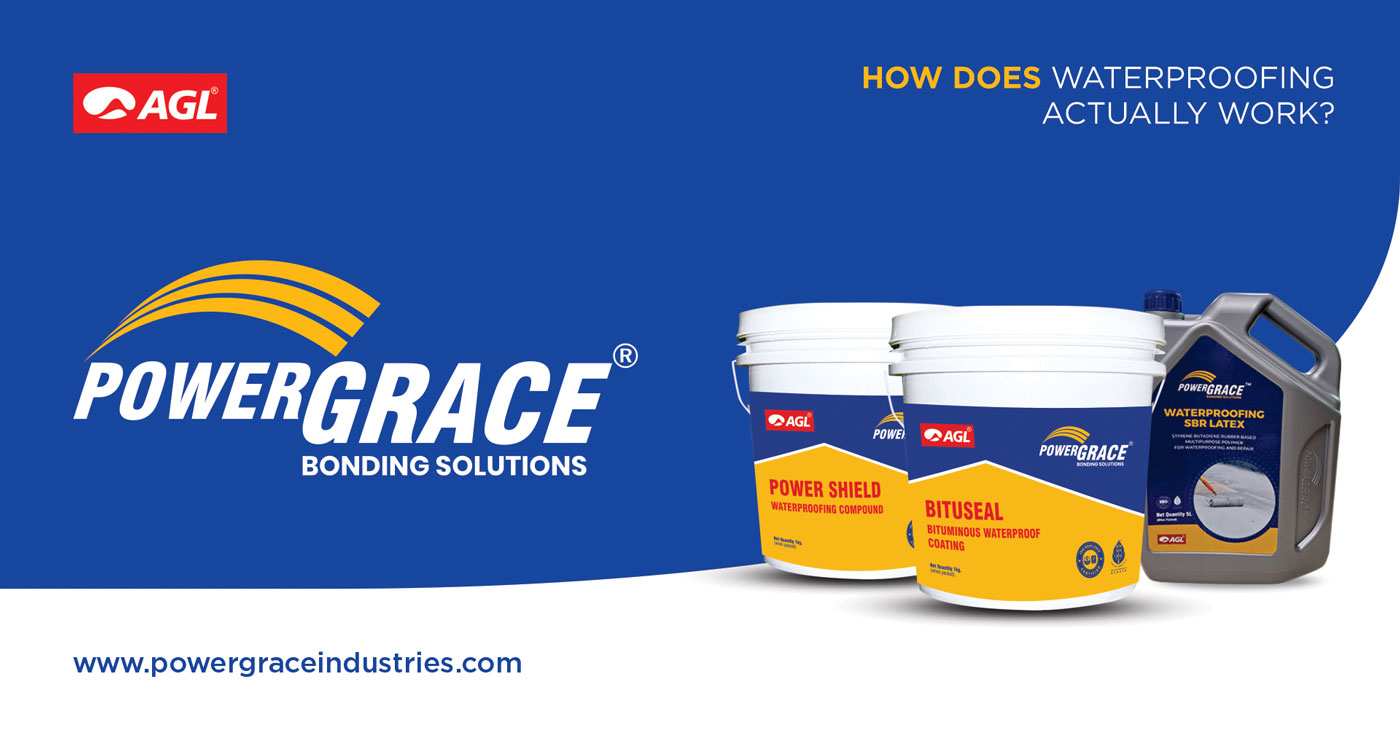
That's where PowerGrace comes in. With specialised waterproofing solutions such as Waterproofing SBR Latex, Power Shield Waterproofing Membrane, and Bituseal Protective Coating, PowerGrace offers solutions for different waterproofing and damp-proofing requirements.
Let's understand how waterproofing actually works and how the right PowerGrace products help protect structures against moisture-related damage.
Waterproofing is the process of making a surface or structure resistant to water penetration by applying specialised protective materials.
Concrete, brickwork, and plaster may appear solid, but they contain microscopic pores and capillaries through which water can travel. Cracks, joints, and surface imperfections can also create pathways for moisture to enter.
When water penetrates these surfaces, it can lead to:
A properly selected waterproofing system helps restrict water penetration and protects the underlying construction materials from prolonged moisture exposure.
To understand waterproofing, it is important to know how water enters a structure.
Water can penetrate construction materials through microscopic pores, capillaries, cracks, joints, and other surface imperfections. In underground structures, hydrostatic pressure can also force water through vulnerable areas.
Waterproofing systems work by interrupting these pathways through different protective mechanisms.
Here are some of the ways waterproofing technology works:
One of the most common waterproofing mechanisms involves creating a continuous protective layer over a surface.
Liquid-applied waterproofing products form a membrane after application and curing. This membrane acts as a barrier between the water and the underlying concrete or masonry surface.
Flexible membranes can also accommodate certain levels of minor surface movement without losing their protective properties.
Power Shield is a single-component, liquid-applied waterproofing membrane formulated with elastomeric acrylic polymers and reinforcing fibres.
Its flexible membrane-forming properties make it suitable for protecting RCC roofs, exposed roof slabs, sunshades, parapets, and brick-bat coba surfaces.
An additional advantage is its heat-reflective property, which helps reduce surface temperatures when applied on exposed roofs.
Another approach to waterproofing involves modifying cement-based materials to improve their bonding, flexibility, and water resistance.
Certain polymer-based additives can be mixed with cement mortar, slurry, or concrete to improve the performance of the resulting material.
These additives help improve adhesion and reduce the permeability of cement-based applications when correctly formulated and applied.
PowerGrace Waterproofing SBR Latex is a synthetic rubber emulsion designed to improve the performance of cement-based materials.
When mixed with cement mortar, slurry, or concrete as recommended, it helps improve adhesion, flexibility, and water resistance.
It is suitable for applications such as:
Its versatility makes it useful for waterproofing, bonding, and repair requirements in different construction applications.
In certain applications, especially below ground level, structures are exposed to continuous moisture from surrounding soil and groundwater.
Bituminous waterproofing systems work by forming a protective coating that helps prevent water and moisture from reaching the underlying concrete surface.
These coatings are particularly useful for foundations, retaining walls, and underground structures that require damp-proofing and protection against water exposure.
PowerGrace Bituseal is a ready-to-use, single-component bituminous emulsion containing rubber.
It is designed for damp-proofing and concrete protection, providing resistance against water attack and mild soil acids and salts.
Its applications include:
By forming a protective bituminous layer, Bituseal helps protect concrete surfaces against moisture and environmental exposure.
Selecting the right waterproofing material is only one part of achieving reliable protection. Proper surface preparation and application are equally important.
Here are some important steps to follow:
Examine the surface for cracks, damaged concrete, loose plaster, honeycombing, and other defects. Identify the source of leakage or moisture before starting the waterproofing process.
Remove dust, dirt, oil, grease, loose particles, and other contaminants. Repair damaged areas and cracks using suitable repair materials. Ensure that the surface is properly prepared according to the selected product's application requirements.
Choose the waterproofing solution based on the application area and exposure conditions.
Follow the manufacturer's instructions regarding mixing, dilution, application tools, and surface conditions. Apply the selected product uniformly while maintaining the recommended coverage and coating thickness.
Allow the waterproofing system to cure or dry as specified in the respective product guidelines. Avoid exposing the treated surface to water before the recommended period.
Where applicable, conduct a ponding or water-retention test after the waterproofing system has achieved the required curing period. This helps identify potential leakage before proceeding with subsequent construction activities.
Before selecting a waterproofing solution, keep the following factors in mind:
Effective waterproofing is not just about stopping visible leaks. It is about preventing moisture from entering the structure and protecting the building against long-term water-related damage.
At PowerGrace, we understand that different construction areas require different waterproofing approaches. That's why our waterproofing range includes specialised solutions for different application requirements.
Selecting the right product and following the recommended application process can help improve the durability and performance of your construction.



Powergrace Bonding Solutions . All rights reserved. | Powered by : Sandhya Branding Agency